Sunday, February 24, 2013

Double-crested Cormorant (Phalacrocorax auritus) of Belize

f/8, 1/640 ISO140; D4, 300mm f/2.8, 2x (600mm); 300ppi,  11.4x17.1 inches

f/8, 1/640 ISO160; V2, 18.5mm f/4 (49mm); 300 ppi, 8.5x12.8 inches
Photographed at Monkey River, Belize on February 14, 2013.

Grace took the photo of me in a speed boat on the Monkey River in Southern Belize trying to take the photo with a 600mm lens (300mm x 2) of a pair of Double-crested Cormorants in flight. What a lifetime dream came true!

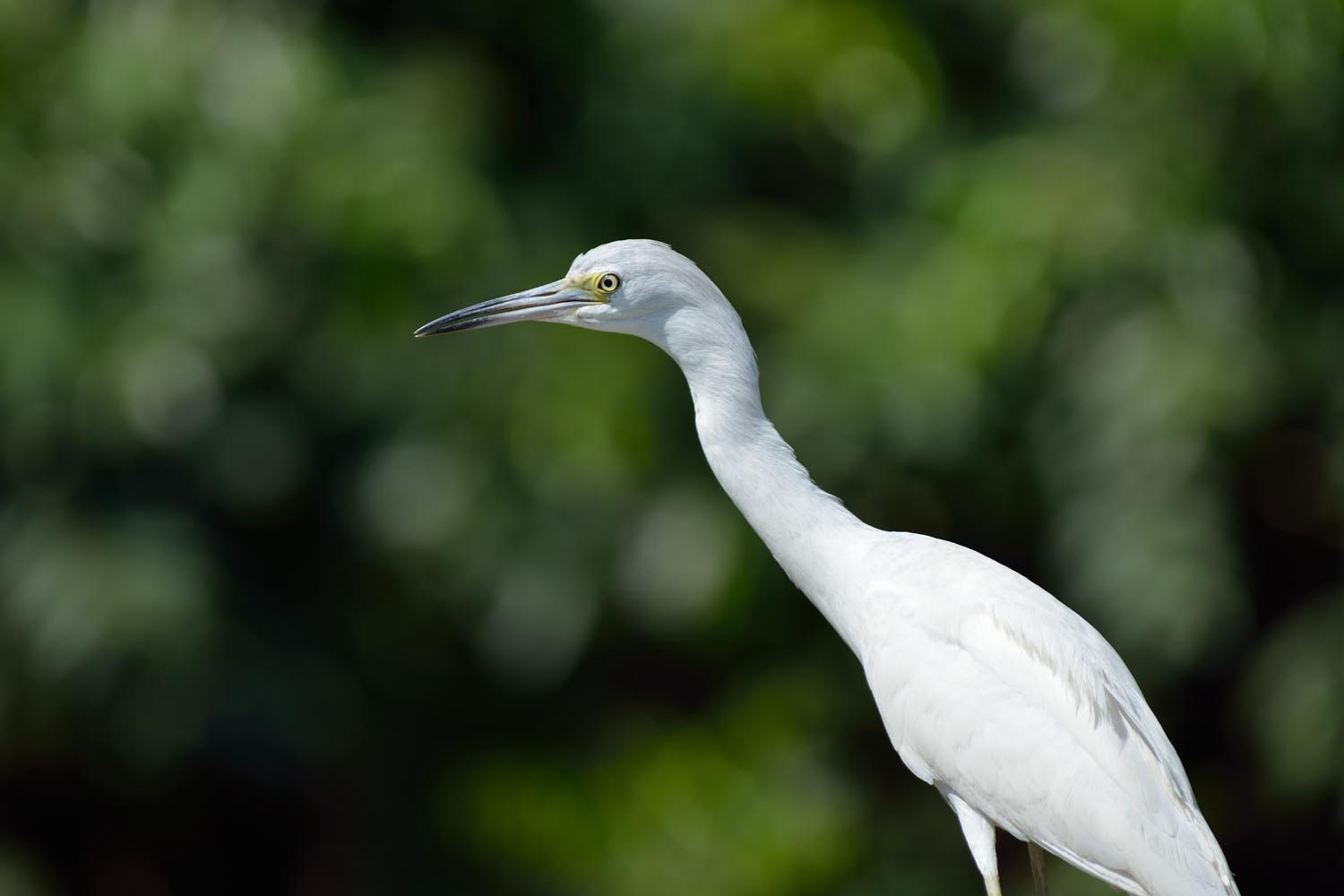
Juvenile Little Blue Heron (Egretta caerulea) of Belize

f/6.3 1/640 ISO400; D800E, 300mm f/2.8, 2x (600mm); 300 ppi, 15x21 inches

f/6.3 1/640 ISO125; D800E, 300mm f/2.8, 2x (600mm); 300 ppi, 15.5x23.3 inches
Photographed at Monkey River, Belize on February 14, 2013.

My hand was not as study in the first shot, the Bokeh in the second image is just simply amazing.  The young bird is identified by its yellow legs.

Little Blue Heron (Egretta caerulea) of Belize

f/6.3, 1/125 ISO450; V2, 70-200mm f/4 at 190mm (513mm); 300 ppi, 6.6x9 inches

f/4, 1/500 ISO140; D4, 300mm f/2.8, 1.4x (420mm); 300ppi,   8.4x12.6 inches
Photographed at Sittee River, Belize on February 12, 2013.

Bare-throated Tiger Heron (Tigrisoma mexicanum) of Belize

f/7.1, 1/320 ISO640; D4, 300mm f/2.8, 1.4x (420mm); 300 ppi, 9.5x14.5 inches

f/6.3, 1/200 ISO400; V2, 70-200mm f/4 at 200mm (540mm); 300 ppi 8.5x13 inches
Photographed at Sittee River, Belize on February 12, 2013.

Friday, February 22, 2013

Female American Darter, Snakebird (Anhinga anhinga) of Belize

f/8 1/640 ISO450; D800E, 300mm f/2.8, 2x (600mm); 300 ppi, 16x24 inches
f/8 1/640 ISO500; D800E, 300mm f/2.8, 2x (600mm); 300 ppi, 13.7x20.6 inches
Photographed at Monkey River, Belize on February 14, 2013.

This is D800E at its best.

Male American Darter, Snakebird (Anhinga anhinga) of Belize

f/4 1/500 ISO125; D4, 300mm f/2.8, 1.4x (420mm)

f/4 1/500 ISO110; D4, 300mm f/2.8, 1.4x (420mm)
Photographed at Sittee River, Belize on February 12, 2013

The long telephoto image gave the picture a two-dimensional feeling and the white over exposed sky in the background further make the images feel like a 19th-century antique bird prints by artist such as John Gould.

Roadside Hawk (Buteo magnirostris) of Belize

f/4, 1/500 ISO140; D4, 300mm f/2.8, 1.4x (420mm)

f/8, 1/250 ISO220; V2, 70-200mm f/4 at 200mm (540mm)
Photographed at Sittee River, Belize on February 12, 2013.

Keel-billed Toucan (Ramphastos sulfuratus) of Belize

f/4, 1/500 ISO140; D4, 300mm f/2.8, 1.4x (420mm)

f/4, 1/500 ISO160; D4, 300mm f/2.8, 1.4x (420mm)

f/5.6, 1/250 ISO320; V2, 70-200mm f/4 at 200mm (540mm)

Photographed at Sittee River, Belize on February 12, 2013.

Thursday, February 7, 2013

Nikon 1 V2, FT1 and AF-S VR Zoom-Nikkor 70-300mm f/4.5-5.6G IF-ED

Lat weekend, I took this set up to the Aviary at Hong Kong Park.  I used auto-ISO of 16--800.  In most instance, the ISO was 800.  The resolution and noise is about the level of my old D300, of cause, it is not as good as the newer D700, D4 or D800.  I can achieve the same image size at 810mm, using 300mm f/2.8 with 2x teleconverter on D800.  I will have the same effective aperture of f/5.6.  However, I will have much better high ISO performance and much better focusing.  But the weight difference between these two sets of equipment would be several folds.  

V2 with FT1 and G lens can only focus in AF-S mode.  If we turn the "Silent Photography" off, the shutter release has two distinct steps, press half-way, the camera signal that the subject is in-focus.  Press fully, the second noise from the camera indicates that the shutter is released.  It is good for focus/re-composition mode.  But it is too slow for the moving subject such as birds.  It is much better to turn "Silent Photography" on and just press the shutter release all the way down.  The camera focusing mechanism is extremely fast and usually can get the subject in-focus instantly.

f/7.1 1/40 ISO800,110mm at 297mm

f/5.6 1/60 ISO800, 240mm at 648mm

f/7.1 1/125 ISO800, 116mm at 313mm

f/5.6 1/200 ISO400, 135mm at 364mm

f/5.6 1/60 ISO800, 85mm at 229mm

f/5.6 1/125 ISO800, 300mm at 800mm

f/5.6 1/25 ISO800, 165mm at 445mm


Friday, February 1, 2013

Nikon 1 V2, FT1 and AF-S VR Zoom-Nikkor 70-300mm f/4.5-5.6G IF-ED

A much cheaper, lighter and more versatile alternative is to use AF-S VR Zoom-Nikkor 70-300mm f/4.5-5.6G IF-ED on Nikon 1 V2.  It makes a 189-810mm package.  As previously mentioned, the focusing may still an issue.  But Nikon 1 V2 can focus very quickly, for moving subject just place the subject in the middle of the viewfinder and keep on pressing the shutter release.  It was amazing how the camera can respond and focus so quickly.

f/8 1/500 ISO160

f/8 1/500 ISO160

f/8 1/1250 ISO160

f/8 1/250 ISO800

f/8 1/200 ISO400


Thursday, January 31, 2013

Nikon 1 V2 and AF-S NIKKOR 300mm f/2.8G ED VR II

Nikon just released its US$ 17899.95 AF-S NIKKOR 800mm f/5.6E FL ED VR which weights 161.6 oz.  Putting on Nikon 1 V2 a AF-S NIKKOR 300mm f/2.8G ED VR II making a 810mm f/2.8 lens.  It is V2 at its best, let us doing things that we normally cannot do.

f/5.6 1/200 ISO160; 300mm at 810mm

Wednesday, January 30, 2013

Nikon 1 V2 vs. D800E

Can you tell which image was taken with Nikon 1 V2 (14.2 MP) and with D800E (36 MP)?

f/4 1/320 ISO100; D800E 24-70mm f/2.8 at 52mm

f/5.6 1/250 ISO220; Nikon V2 105mm at 283mm
The two images, both were RAW, were processed exactly the same using NX2.  I could not tell which one has better resolution either at 100% or adjusted to the same size.  There is a very capable sensor in the Nikon V2.

Nikon 1 V2, FT1, AF-S VR Micro-Nikkor 105mm f/2.8G IF-ED

 Got the Nikon 1 V2 shipped from Adorama yesterday.  It is still not available in Taiwan.  I tried it with AF-S VR Micro-Nikkor 105mm f/2.8G IF-ED lens.  It is one of the sharpest lens from Nikon and it has worked well with the previous version of V1.  V2 ergonomically is a much better camera than V1.  I would like to see whether the ISO performance is also getting better.  It has a base ISO of 160 as compare to V1's 100.  The focusing is still a problem: the autofocus only worked with G lens and only with the central focusing point at AF-S mode.  The auto ISO also worked much better, now take into consideration of the focal length of the lens (105 mm x 2.7 thus 1/250).  I set the auto ISO at 160-800.  You can see how the camera was working from the metadata of each image.

f/7.1 1/250 ISO220

f/7.1 1/250 ISO360

f/7.1 1/250 ISO280

f/8 1/250 ISO160

f/8 1/400 ISO160

f/3.2 1/25 ISO800

f.3.2 1/20 ISO800
f/5.6 1/2000 ISO160
I need to do a little bit of noise reduction for the Japanese dolly's white face otherwise the image at ISO800 is quite acceptable.  When I do macro, I will set the focusing at single point, AF-C and shutter release at focus priority in order to get the sharpest image.  This set up is not possible with V2.  However, it is also beyond the point, Why do we need to do marco with V2, other than we can stand back a bit more from the subject.  I like V2 is to use it on condition that we normally not easy to achieve form DSLR, the long-telephoto situation.


Sunday, January 27, 2013

AF-S NIKKOR 300mm f/2.8G ED VR II with TC-14E and TC-20E III: D4 vs. V1

The weather suddenly warmed up when I visited Taipei Zoo for testing the AF-S NIKKOR 300mm f/2.8G ED VR II lens.  The flamingo swam in the pond like a swan and dipped its head quickly into the water to cool itself down.  The movement was too quick to use single-spot and AF-C focusing.  I was quite confident with the even background, the bright color of the bird and especially the clear yellow eye would activated the facial recognition of the D4 focusing system.  I switched the focusing to Auto and AF-C.  It was such a joy to photograph, D4 nailed the focus 9 out of 10 times.  With TC-14E converter, the focal length is 420mm.  I used f/5.6, the camera auto-ISO set the speed automatic to 1/500 and ISO160.


Here is an enlarged view and we can see the water freeze in action.


The enlarged image looks good on the web, but in reality, at 300 dpi, the image is only 5.45 x 3.63 inch, 1.8 MP.

Here is an image shot with the same lens with TC-20E and V1, a 35 mm focal length equivalent of 1620mm.

The image size at 300dpi is 12.9 x 8.6 inch, 10.1 MP.  However, it was a pain to use the V1 with the lens, only one single focusing point in the center can be used at AF-S.  I have to set the ISO at 100 to get the best image quality, at f/8 the speed is 1/60.  Because of VR, it is not too slow to get sharp image from the lens but it is often too slow for the bird in action.  Furthermore, whenever a shot was taken, the viewfinder freeze to show a preview.  Opposite to D4, only one out of 10 shots is good.

Using more realistically, AF-S NIKKOR 300mm f/2.8G ED VR II and V1 make an incredible  810mm f/2.8 combination.  Hopefully with the new V2's better ergonomics, better ISO performance and 14.1 MP, the experience will be a much better one than V1.

Nikon D800E, D4, D7000 and V1 image size

D800E and D4 are full frame FX format, the sensor size is 36 x 23.9mm; D7000 is DX format, the sensor size is 23.6 x 15.6mm; V1 is CX format, the sensor size is 13.2 x 8.8mm.

D800E sensor is 36 MP; D4 and D7000 sensor is 16.2 MP; V1 is 10.1 MP

Here is an image taken with D800E, AF-S NIKKOR 300mm f/2.8G ED VR II and TC-20E III.  The image is 36 MP.


Here is the image cropped to 16.2 MP, the image size of D4.


Here is the image cropped to DX format (1.5x) of D7000.  As we can see the images of D4 and D7000 are identical.  It means, if we decrease the size of the sensor of D800E to DX format, it will have the same pixel of 16.2 MP as D4. But D4 still have larger FX format sensor, a situation similar to that between D3 and D300.  In which, both camera are 12 MP but one in FX format and the other in DX format.  Thus it will be unlikely that Nikon will ever make another professional camera in DX format.  People want to use DX format can simply just put their DX lens on D800.


Here is the image cropped to the CX format (2.7x) of V1.

AF-S NIKKOR 300mm f/2.8G ED VR II with D4, D800E and V1


There is another way of bring the subject closer or bigger other than using longer and longer focal length lens.  We can decrease the size of camera sensor or increase its pixel density.  D4 and D800E are both full frame with sensor size of 36 x 23.9 mm.  V1 is CX format of 13.2 x 8.8 mm with a crop factor of 2.7x.  D4 is 16.2 MP, D800E is 36 MP and V1 is 10.1 MP.  Here are comparison of images view at 100%.

Here are images using AF-S NIKKOR 300mm f/2.8G ED VR II:

AF-S NIKKOR 300mm f/2.8G ED VR II with D4

AF-S NIKKOR 300mm f/2.8G ED VR II with D800E

AF-S NIKKOR 300mm f/2.8G ED VR II with V1
Here are images using AF-S NIKKOR 300mm f/2.8G ED VR II and TC-14E II:

AF-S NIKKOR 300mm f/2.8G ED VR II, TC-14E II with D4

AF-S NIKKOR 300mm f/2.8G ED VR II, TC-14E II with D800E

AF-S NIKKOR 300mm f/2.8G ED VR II, TC-14E II with V1
Here are images using AF-S NIKKOR 300mm f/2.8G ED VR II and TC-20E III:

AF-S NIKKOR 300mm f/2.8G ED VR II, TC-20E III with D4

AF-S NIKKOR 300mm f/2.8G ED VR II, TC-20E III with D800E

AF-S NIKKOR 300mm f/2.8G ED VR II, TC-20E III with V1

LinkWithin

Related Posts with Thumbnails